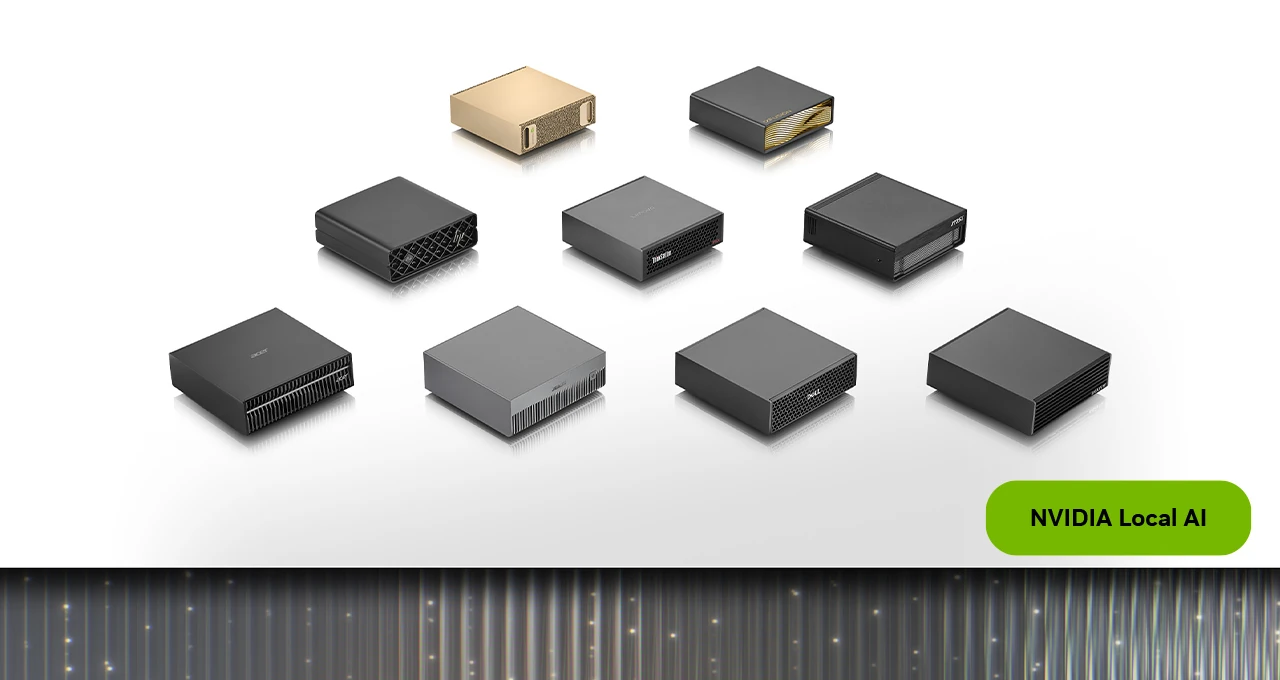
Nvidia has released its mini-supercomputer, the DGX Spark, in a 64 GB version priced at $4,999. The system also offers the option to link two units, aggregating memory up to 128 GB. While this offering makes the GB10 ecosystem more accessible than the 128 GB model, the term "accessible" remains relative: the machine targets teams that value privacy and local prototyping, not general consumers seeking an AI PC.
Nvidia introduced the new DGX Spark 64 GB as a gateway to developing local artificial intelligence models. The machine utilizes the family's compact form factor and GB10 architecture but reduces the unified memory compared to the higher-capacity 128 GB version. Its announced price of $4,999, with availability starting October 23rd from partners, confirms its status as a specialized professional tool rather than a conventional mini-PC.
Understanding Local AI Compute Limits
Memory is the central data point in this category. To run a model locally, available capacity often dictates what can be loaded before compute power even comes into play. Nvidia states that a DGX Spark 64 GB can support models up to approximately 100 billion parameters, depending on format and quantization. This ceiling does not guarantee fast performance for all such models or ensure that the entire memory will remain free for context and tools; rather, it provides an order of magnitude reference point for prototyping capacity.
A key feature highlighted is connecting two units via the ConnectX-7 interface. The resulting pooled capacity reaches 128 GB, allowing Nvidia to cite support for running models up to 200 billion parameters. This configuration appeals to a team planning phased expansion. However, potential users must compare this against an integrated 128 GB system, as distributing a model introduces inter-enclosure communication, software complexity, and limitations based on supported architectures.
Nvidia announced double the bandwidth and up to 1.7 times the performance in one test performed using Qwen 3.8 27B. The company notes that manufacturer-provided results describe a specific scenario; actual performance will vary depending on quantization, context length, number of users, and the inference engine. Independent tests should measure token throughput, time-to-first-token latency, power consumption, and stability over long sessions.
Value Beyond Specifications: The Ecosystem Advantage
The value of the DGX Spark lies as much in its ecosystem as in its specifications. Nvidia delivers a robust software stack that includes CUDA, tools for Nemotron, Ollama, vLLM, and PyTorch models, along with an assistant designed specifically for cluster creation. For a small team, gaining several days of integration time alone can justify part of the cost. While a less expensive assembly built from consumer components might offer more raw performance, it typically demands greater configuration, maintenance, and memory trade-offs.
Local computing addresses three core organizational needs:
- Privacy: Documents, code, or research data remain within the organization's physical boundaries.
- Predictability: A purchased machine does not charge per token and can function independently even if remote services change their pricing or availability.
- Low-level Experimentation: Users gain direct access to the model, weights, and infrastructure itself.
These benefits, however, must be carefully weighed against costs like electricity, administration, and hardware renewal.
Cost Analysis and Practical Considerations
At $4,999, the DGX Spark is not inexpensive; two units approach the price point of on-premises infrastructure, exceeding the cost of many standard workstations. For a team with irregular overhead costs, cloud rental capacity might be preferable. Conversely, another team that handles sensitive data daily or develops offline can amortize the machine over time. The calculation must factor in the expected utilization rate, not just the initial purchase price.
The 64 GB version also addresses memory pressure within the rapidly growing AI ecosystem. As models and context windows expand, configurations with large amounts of memory remain rare and expensive. While Nvidia proposes a modular upgrade path, they maintain tight control over both the hardware and software stack. Success will depend on the ability to genuinely connect units without confining users to only a few optimized demonstrations.
Finally, the compact format enables laboratory, office, or field use cases that are impossible with traditional server racks. It is important to note that this does not transform the Spark into a laptop or general-purpose workstation. Factors such as noise, heat dissipation, connectivity, storage, and backup will be critical in any real installation. Companies must also define stringent access policies: a local model only protects data if the machine, its logs, and physical copies are properly secured.
Ultimately, the DGX Spark 64 GB is a barrier reducer, not a democratizing tool. It allows entry into the Nvidia stack with less memory capacity that can then be scaled up modularly. Its relevance will be strongest for teams that know precisely which models they want to run, how frequently, and why cloud solutions are unsuitable for their needs. For others, however, the price tag and complexity of linking units risk turning the promise of local sovereignty into underutilized hardware.
Before making a purchase decision, users should test their target model on 64 GB, calculate projected usage over a full year, and compare two linked Sparks against both an integrated 128 GB machine or established cloud services: the optimal choice depends strictly on the utilization rate, not simply the "local AI" slogan.