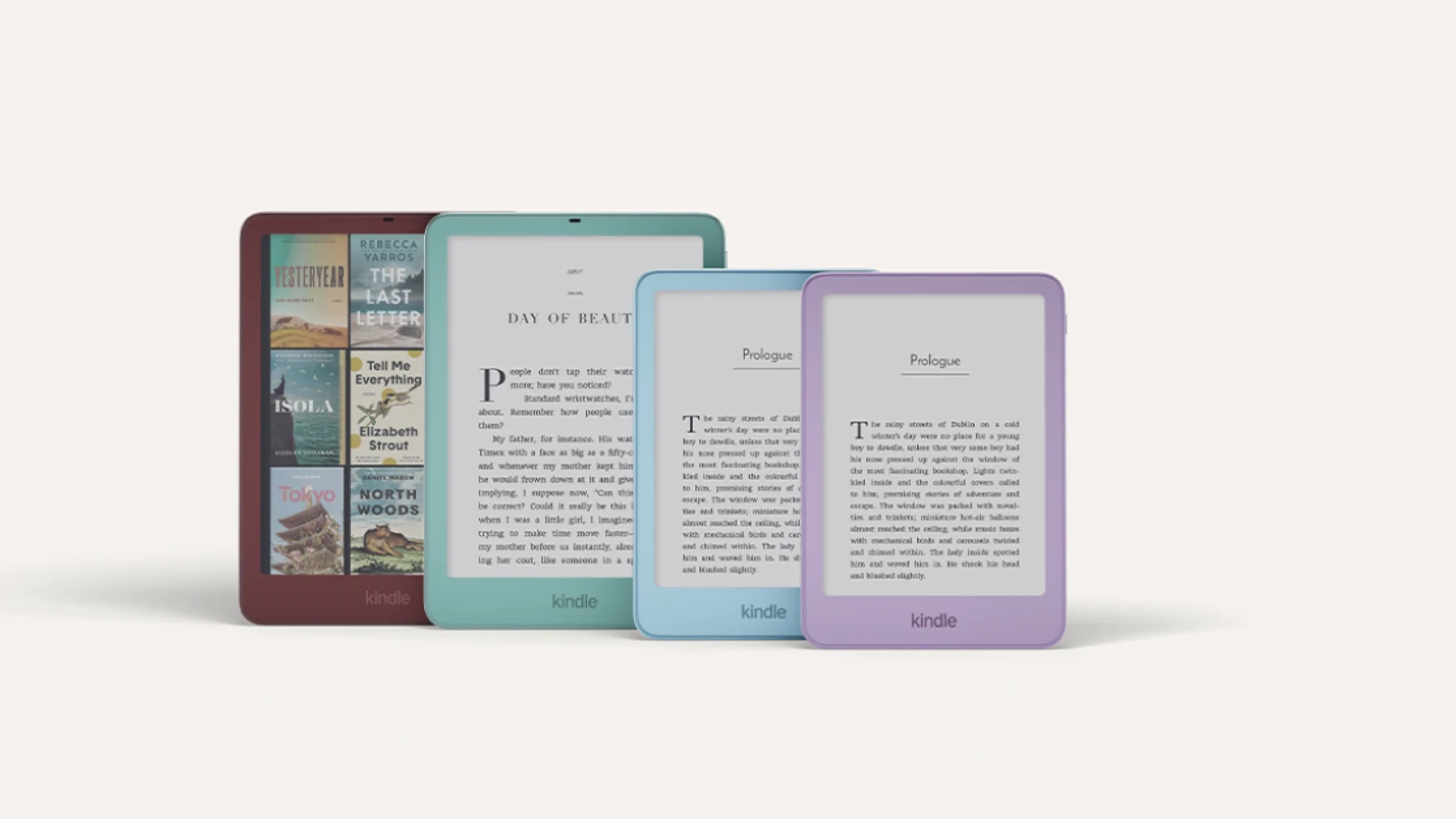
Amazon is updating its entire Kindle family without pursuing a singular disruptive effect. Flush screens, faster opening times, improved Colorsoft displays, Kindle Click, and new accessories suggest an overall ecosystem strategy: reducing every minor friction point between opening a book and turning the next page.
The anticipated 2026 Kindle refresh feels less like the arrival of a revolutionary device and more like a coordinated upgrade across the entire lineup. Amazon is tweaking the entry-level model, the Paperwhite, and the Colorsoft, while also adding accessories designed to change how users hold and interact with the e-reader. The commercial objective is clear: provide an accessible entry point at every price tier while giving existing owners a reason to stay within the ecosystem.
Updates Across the Kindle Lineup
The basic Kindle retains a six-inch screen and 16 GB of storage, but Amazon announced specific improvements including a 30% faster book opening time and up to six weeks of battery life. The introduction of a flush screen replaces the recessed bezel, modernizing the design and making it easier to clean. An expanded choice with an aluminum version featuring 32 GB increases options, although this additional capacity minimally affects standard e-books, making it more relevant for comics, large documents, and audio usage.
The Paperwhite remains the balance model in the lineup. Its TFT oxide matrix screen is expected to improve responsiveness and efficiency, while features like warm lighting and waterproofing address evening, bath, or beach use cases. Amazon announces up to twelve weeks of battery life. The Signature Edition adds 32 GB storage, charges via a pogo connector, and includes double-tap control. These features don't revolutionize reading, but they aim to keep the device ready at all times—placed on a stand rather than stored with a cable.
The Colorsoft carries the most visible technological evolution. Amazon emphasizes nitride LEDs, an oxide ink background, and custom waveforms to achieve richer colors. However, color e-ink remains a compromise; it does not aim for the saturation or fluidity of a tablet. Its value lies in covers, graphics, annotations, and comics, while still maintaining a reading experience closer to paper with superior battery life compared to LCD or OLED screens.
Accessories Center the Experience on Gestures
The accessories signal that the battleground is now centered on eliminating manual interaction points. Kindle Click is a $35 remote control allowing users to page turn without touching the screen. While this may seem superfluous, it addresses concrete situational hurdles: using an e-reader placed on a stand, when hands are under a blanket, in the kitchen, for individuals with reduced mobility, or during long reading sessions where holding the device is inconvenient. Notably, the announced compatibility with Kindles released since 2024 protects current owners and prevents this feature from being restricted solely to the next generation.
Amazon also offers a cover with page control and a docking station. Taken separately, these items appear modest. Together, however, they transform the e-reader into an installed reading screen: it is placed down, charged, and advanced remotely. This evolution draws the Kindle closer to a household appliance without replicating the distractions of a tablet. Furthermore, this accessory ecosystem opens up a new margin source, extending the commercial relationship beyond the initial device purchase.
Beyond the Hardware Refresh
However, the complexity increases for the consumer. Between increased storage capacity, varied materials, Signature Edition options, color capability, and accessories, a reader may struggle to identify the true area of improvement. The useful question is less "which Kindle is best?" and more "what problem needs solving?" For reading novels, the basic model is often sufficient. Warm lighting and waterproofing justify the Paperwhite for regular readers, while the Colorsoft targets those whose content genuinely benefits from color graphics.
When evaluating this refresh against longevity, one must remember that an e-reader can function well over many years, and the environmental benefit of electronic paper diminishes if generations are replaced too quickly. From this perspective, the compatibility of Kindle Click with devices since 2024 is a stronger signal than any minor performance increase.
Ultimately, the device cannot be separated from the bookstore. The convenience of purchasing methods, subscriptions, protected formats, and syncing explain much of the Kindle's power. Better hardware solidifies the attachment to the platform but still raises questions about book portability and dependence on the Amazon account. The immense convenience of the ecosystem is precisely what makes leaving it difficult.
The 2026 family does not reinvent the e-reader; it refines the reading moment: faster startup, cleaner screen, adapted lighting, better controlled color, and remote page turning. For a new buyer, this coherence makes the lineup more persuasive. For an existing owner, the most rational purchase may be an accessory—or none at all—rather than opting for a brand-new device.