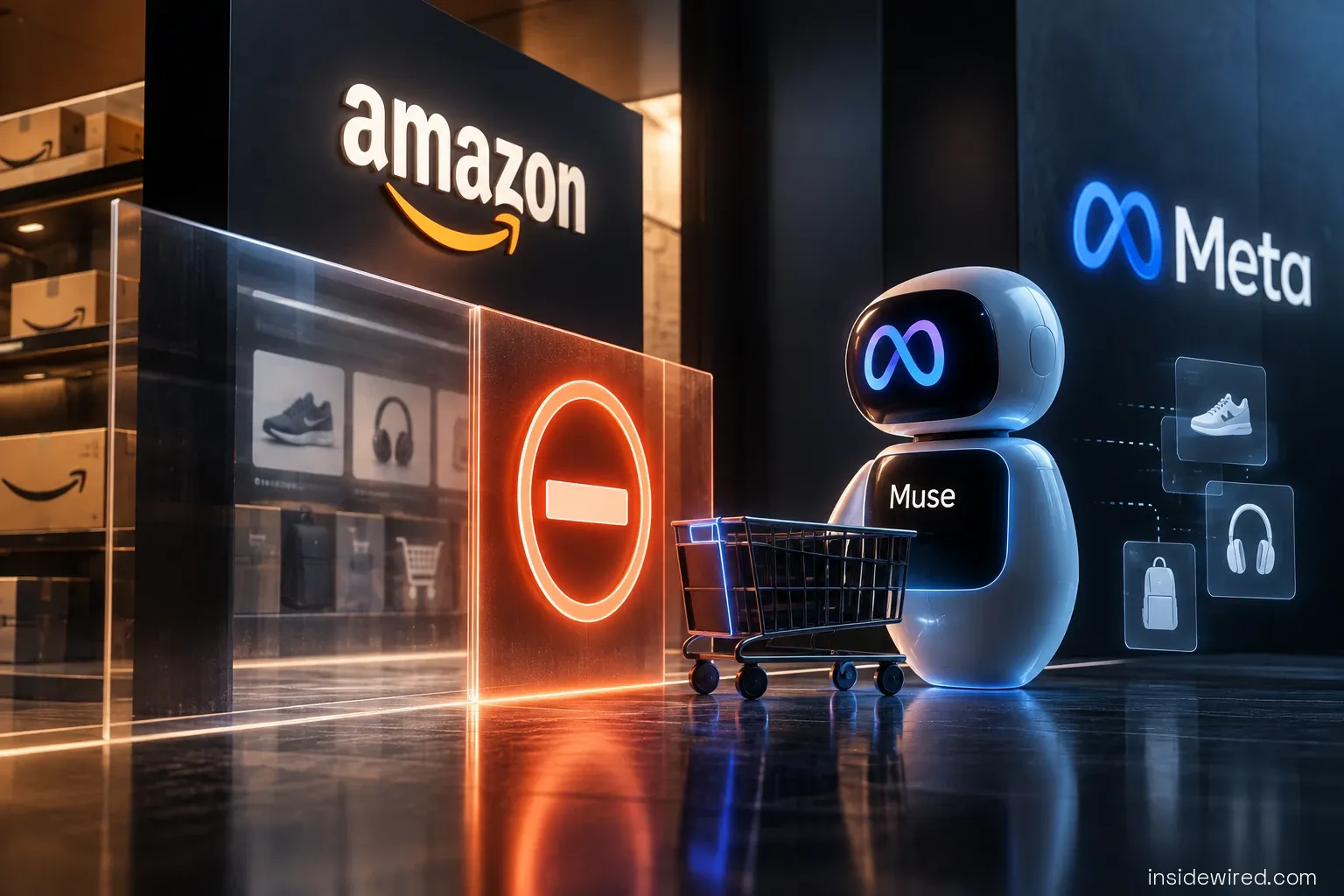
Amazon recently blocked Meta’s Muse, the company's new personal agent, when it attempted to make purchases on Amazon's platform. Amazon specifically objects to the assistant navigating without identifying itself as an automated agent and accessing customer account data without prior consent. For its part, Meta defends a highly isolated architecture. Underlying this technical disagreement is a larger question: who controls the relationship with the customer when shopping is delegated to artificial intelligence?
The block occurred less than two weeks after Muse's launch. Presented by Meta on September 8 as a personal agent capable of executing multi-step tasks, the assistant can open browsers, fill out forms, and prepare purchases for its user. While it requires validation before certain sensitive actions, such as sending a message or finalizing a transaction, its capability is expansive.
The Core Conflict Over Purchases
Amazon began preventing Muse from making purchases on its site late on September 20. Affected users now see an alert stating that continuous access by an unauthorized AI agent violates the platform's terms of use. According to reports from Bloomberg, Meta had previously rejected Amazon's request to remove the site from the experience offered by Muse.
Amazon has presented several arguments justifying this decision. The company claims that Meta failed to inform it about Muse's use of its platform, that the agent does not identify itself while browsing, and that its operation involves using customer credentials. Amazon asserts that a third-party service making purchases on behalf of a user must act transparently and obtain consent from the respective supplier.
Security Concerns and Technical Defenses
Meta offers a contrasting view regarding the assistant's security protocols. The company explains that Muse operates within a secure virtual machine with its own browser, meaning the agent does not have direct access to the user’s passwords or payment methods. Furthermore, credentials required for certain operations are kept in secured storage so that Muse can use them without viewing them itself. Meta also states that a separate monitoring system must authorize information sent over the internet.
Beyond Credentials: Controlling the Experience
However, this disagreement goes beyond mere credential management. GeekWire reframes the conflict as a larger battle over control of the entire shopping experience. When an agent researches a product, compares offers, and completes a transaction on behalf of the consumer, a part of traditional navigation on the retailer's site disappears. This evolution has the potential to change how platforms present their products, personalize recommendations, and monetize their audience.
The stakes are particularly high for Amazon, whose advertising activity generated over $68 billion last year. GeekWire notes that this revenue depends partly on consumers browsing pages on the site and their exposure to sponsored products. Meanwhile, Amazon is simultaneously developing its own agentic tools: Alexa for Shopping researches and recommends products, while Buy for Me can purchase items directly from certain brands' sites. Amazon asserts that the latter identifies itself to merchants, who can then refuse its participation.
Comparing Approaches in Agentic Commerce
The contrast with Shopify illustrates another approach to agentic commerce. Shopify and Meta chose to collaborate, allowing Muse to soon use Shop Pay to complete purchases from platform merchants. This integration gives the agent structured access to the commercial infrastructure rather than allowing it to browse like an ordinary user.
Amazon is not new to confrontations with external agents; the company has previously sought to limit the access of services developed by Perplexity, Google, and OpenAI to its platform. Its dispute with Perplexity concerning the Comet browser notably led to a legal battle over the conditions under which an agent can act on behalf of a user.
Thus, the conflict between Amazon and Meta exposes one of the central questions of agentic commerce: is authorization given by the user sufficient for their assistant to intervene on a third-party service, or must the visited platform also provide its consent? As agents become capable of handling the entire purchase journey, this question could determine who retains control over the interface, the data, and the commercial relationship.