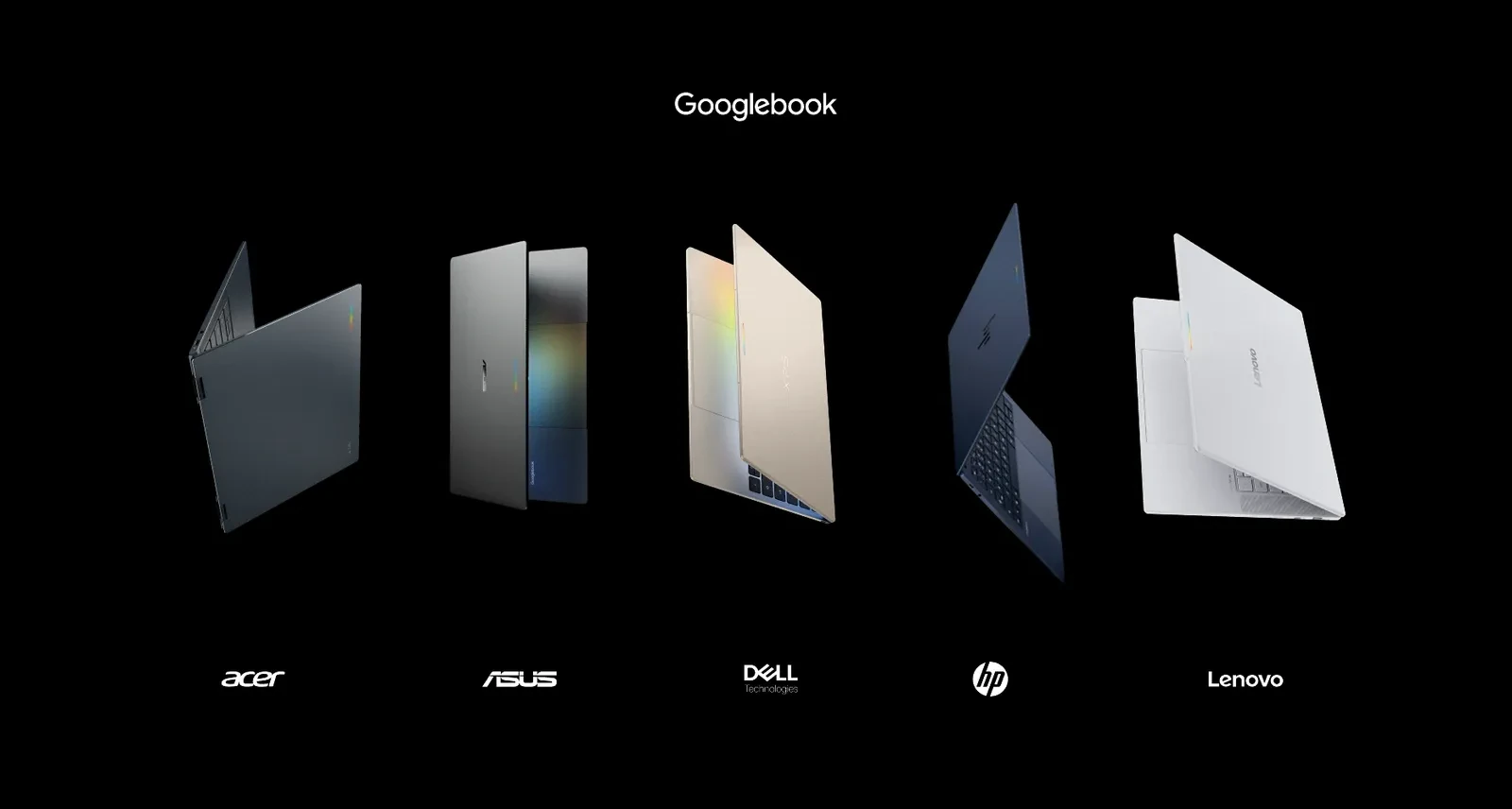
Google has opened pre-orders for its first Googlebooks, a new category of high-end laptops designed around Android, based on ChromeOS foundations, and powered by Gemini. Manufactured by Acer, Asus, Dell, HP, and Lenovo, these models aim to transcend the Chromebook image by offering native Android applications, Linux tools, deep smartphone integration, and AI functions built directly into the desktop environment.
A Strategic Shift in Google's Computing Line
The Googlebook represents a major strategic shift in Google’s computer division. Rather than simply evolving ChromeOS by adding more Android elements, Google chose Android as the technological foundation for its new operating system while incorporating several features adapted from ChromeOS for desktop use. The Verge detailed this evolution, which originated from the internal project Aluminium, noting that Google is now focused on building a platform capable of directly extending its mobile ecosystem to PCs.
This native Android origin is immediately visible in the Googlebook OS. Upon first use, 9to5Google noted that visual and functional conventions similar to Android are present in quick settings, notifications, and numerous interactions, while still retaining a desktop, taskbar, and overall organization familiar to ChromeOS users. This proximity also allows Android applications to function natively alongside web apps and a full Linux environment intended particularly for developers.
Seamless Integration and AI Capabilities
Google emphasizes seamless continuity between the smartphone and the computer. Features like Continue On allow users to resume an activity on the Googlebook that was started on an Android phone. Furthermore, the Files app can access photos and files from the smartphone, while Cast My Apps allows displaying and controlling mobile applications within a desktop window. During setup, settings, passwords, Wi-Fi networks, and messages can also be transferred directly from the phone.
Gemini constitutes another major pillar of the platform. Magic Pointer allows users to invoke artificial intelligence directly from the cursor based on text, images, or context displayed on screen. Rambler transforms free dictation into organized text, and Create My Widget lets users generate widgets from a simple description. Additional integrations include Gemini Live, automations, and contextual suggestions. Some tasks can continue running in the background with Gemini Spark even when the computer is closed.
Hardware Specifications and Market Positioning
The manufacturers are offering five launch machines, starting at an entry price of $899 USD in the United States. Acer, Asus, Dell, HP, and Lenovo all participate in the initial rollout. Ars Technica points out that this strategy firmly positions the line in the premium segment: the Acer model serves as the entry-level option, while other launching configurations start between $1,199 and $1,299.
These machines utilize Intel Core Ultra Series 3 or Qualcomm Snapdragon X Elite processors and feature a minimum of 16 GB of memory. Their NPUs exceed 45 TOPS to accelerate artificial intelligence processing on the device. Configurations vary by manufacturer, featuring touchscreens that can reach 3K OLED resolution, haptic trackpads, and chassis made from materials such as aluminum, magnesium, or carbon fiber. Google advertises up to 14 hours of video playback and 16 hours of web browsing on certain models. The Glowbar also makes a comeback: this external light strip indicates the charge level and can react during interactions with Gemini.
Professional Use Cases and Security
The Googlebook is designed for creative and professional use cases. Applications such as Adobe Photoshop, Lightroom, and CapCut run natively, while an isolated Linux environment enables the use of development tools and command-line agents. Google has also integrated Antigravity, its AI-assisted development platform. The dedicated Linux environment runs on an isolated pKVM hypervisor, and general security maintains several principles inherited from ChromeOS, including a Google Titan hardware root of trust.
While initial hands-on testing remains necessary before full commercialization—with 9to5Google judging the hardware experience more convincing than expected and Ars Technica reminding readers that prolonged independent testing is yet to come—the overall aim is clear. With the Googlebook, Google aims not simply to offer a more powerful Chromebook, but to make Android a genuine desktop computing platform, closely linked to the smartphone and built around Gemini. The primary challenge will be demonstrating whether this combination of Android, Chrome, Linux, and artificial intelligence can justify its market position against established Mac and Windows PCs already in use.